Molecular Orbital Diagrams
While PyQInt provides access to molecular orbital energies and coefficients, the construction of molecular orbital (MO) diagrams is handled externally using the PyMoDia package. PyMoDia is a dedicated tool for building clear and customizable MO diagrams from quantum-chemical data. The PyMoDia package is documented separately at: https://ifilot.github.io/pymodia
In this section, we demonstrate how results obtained from PyQInt can be exported and visualized using PyMoDia.
Warning
PyMoDia currently only support restricted Hartree-Fock calculations.
Overview
PyMoDia represents molecular orbital diagrams as energy-level schemes, optionally including fragment orbitals, interaction arrows, and symmetry-adapted labels. To simplify interoperability, PyMoDia provides helper routines that can automatically extract the relevant information from PyQInt Hartree-Fock results.
PyMoDia can be easily installed via
pip install pymodia
Canonical Molecular Orbital Diagram for CO
The following example constructs a canonical molecular orbital diagram for carbon monoxide (CO) using Hartree-Fock/STO-3G orbitals computed with PyQInt.
import os
from pymodia import MoDia, MoDiaData, autobuild_from_pyqint, MoDiaSettings
from pyqint import MoleculeBuilder, HF, FosterBoys

# Perform PyQInt calculations for CO
mol = MoleculeBuilder.from_name('co')
res = HF(mol, 'sto3g').rhf()

# Adjust PyMoDia visualization settings
settings = MoDiaSettings()
settings.orbc_color = '#555555'
settings.arrow_color = '#CC0000'

# Automatically construct molecule and fragment definitions
mol, f1, f2 = autobuild_from_pyqint(res, name='co')

# Retrieve molecular orbital energies
moe = res['orbe']

# Slightly shift one orbital level to improve visual separation
moe[6] += 0.1

# Build PyMoDia data object
data = MoDiaData(mol, f1, f2)
data.set_moe(moe)

# Construct and export the MO diagram
diagram = MoDia(
    data,
    draw_level_labels=True,
    level_labels_style='mo_ao',
    mo_labels=['1σ', '2σ', '3σ', '4σ', '1π', '1π', '5σ', '2π', '2π', '6σ'],
    settings=settings
)

diagram.export_svg(
    os.path.join(os.path.dirname(__file__), "mo_co_canonical.svg")
)
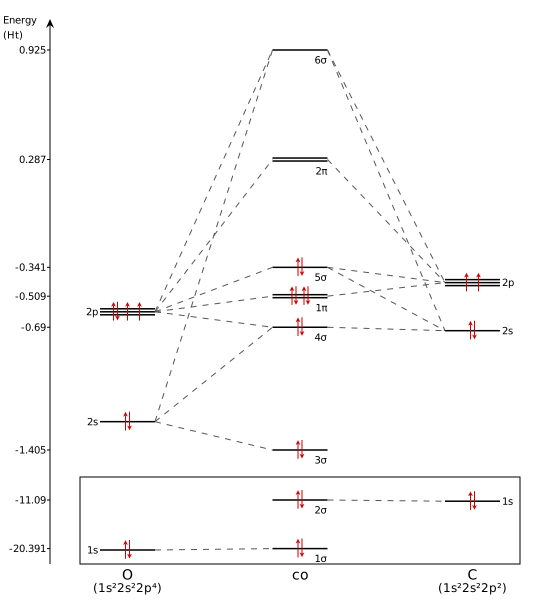
Molecular orbital diagram for the canonical molecular orbitals of CO.
Note
Atomic orbital (AO) energy levels shown in PyMoDia diagrams are obtained from an internal element-specific dictionary and are intended for qualitative visualization purposes only. They do not necessarily represent the true atomic orbital energies for a given calculation and may be adjusted manually (see the PyMoDia manual). Quantitative AO energies can, in principle, be obtained from unrestricted Hartree–Fock calculations on the isolated atoms, which are not yet supported in PyQInt.
Tip
For complex molecules or closely spaced orbital manifolds, it is sometimes necessary to apply small visual offsets to selected molecular orbital energy levels in order to avoid overlaps in the diagram. In the example above, the energy of the \(5\sigma\) orbital is shifted slightly upward to separate it from the degenerate \(2\pi\) levels.
It is important to emphasize that:
These adjustments affect only the vertical placement of the orbital levels in the diagram
The numerical energy values displayed in the figure correspond to the original, unmodified Hartree-Fock orbital energies
The underlying quantum-chemical results remain unchanged
Such adjustments are therefore purely cosmetic and serve only to improve the clarity and readability of the resulting MO diagram.
Localized Orbital Diagrams
PyMoDia can equally well be used to visualize localized molecular orbitals, such as those obtained via Foster-Boys localization. Since orbital localization corresponds to a unitary transformation of the occupied subspace, the localized orbitals can be passed directly to PyMoDia using the same workflow.
Localized MO diagrams often provide a more chemically intuitive picture, making bonding patterns and fragment interactions easier to interpret, while retaining a direct connection to the underlying PyQInt calculation.
import os
from pymodia import MoDia, MoDiaData, autobuild_from_pyqint, MoDiaSettings
from pyqint import MoleculeBuilder, HF, FosterBoys

# Perform PyQInt calculations for CO and its localization
mol = MoleculeBuilder.from_name('co')
res = HF(mol, 'sto3g').rhf()

# adjust settings
settings = MoDiaSettings()
settings.orbc_color = '#555555'
settings.arrow_color = '#CC0000'

# making diagram for localized orbitals
resfb = FosterBoys(res).run()
resfb['nuclei'] = res['nuclei'] # no longer required from PyQInt >= 1.2.0
mol, f1, f2 = autobuild_from_pyqint(resfb, name='co')

# we make here a small adjustment to the height of the third orbital to avoid
# overlap with the triple degenerate state of the localized MOs of CO
moe = resfb['orbe']
moe[2] -= 0.5
moe[6] += 0.1

# build data object
data = MoDiaData(mol, f1, f2)
data.set_moe(moe)

# construct diagram
labels = [''] * len(resfb['orbe'])
diagram = MoDia(data, draw_level_labels=True, level_labels_style='mo_ao',
                mo_labels=labels,
                settings=settings)
diagram.export_svg(os.path.join(os.path.dirname(__file__), "mo_co_localized.svg"))
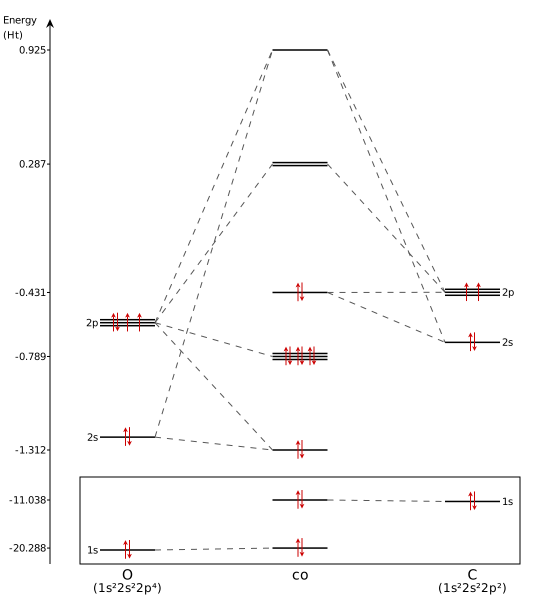
Molecular orbital diagram for the localized molecular orbitals of CO. Note that we observe a threefold degenerate state correspond to the C-O triple bond.