Benchmarks
To probe the performance of PyDFT, we performed a number of scaling tests, which are shown below. All scaling tests were executed on a workstation equipped with an Intel(R) Core(TM) i9-10900K CPU @ 3.70 GHz. The reported timings therefore reflect the performance of PyDFT on this specific hardware configuration.
Execution times
The observed scaling behavior of PyDFT follows a clear power-law trend. When varying the number of angular grid points, the computational cost scales approximately as \(N_\mathrm{ang}^{1.5}\). In contrast, scaling with respect to the total number of grid points yields a lower exponent of about \(N_\mathrm{grid}^{1.2}\). This behavior is consistent with a near-linear scaling in the radial grid size combined with a superlinear (approximately 1.5-power) scaling in the number of angular points.
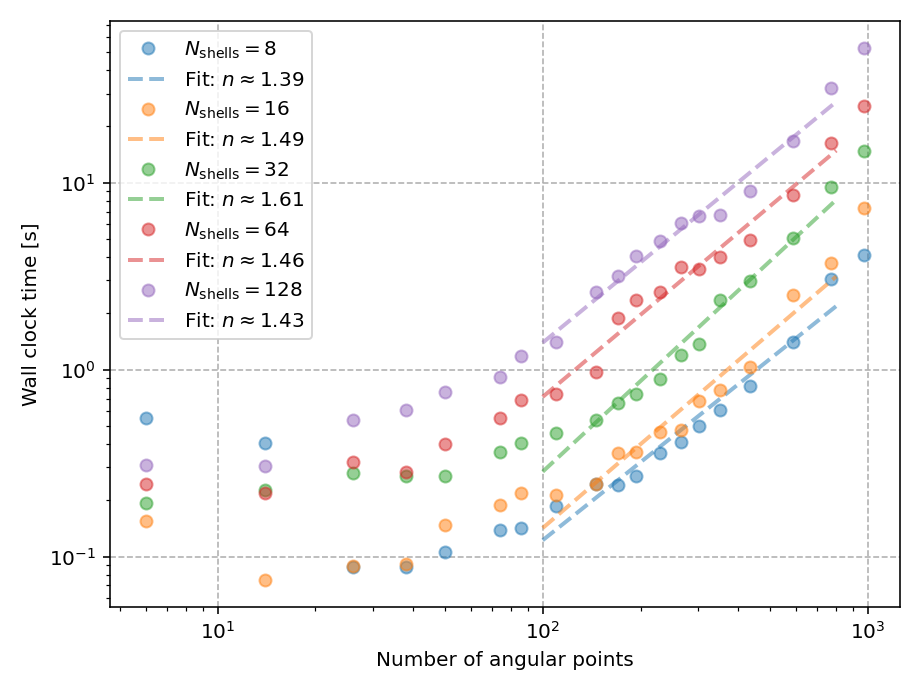
Scaling of the wall-clock time with respect to the number of angular points.
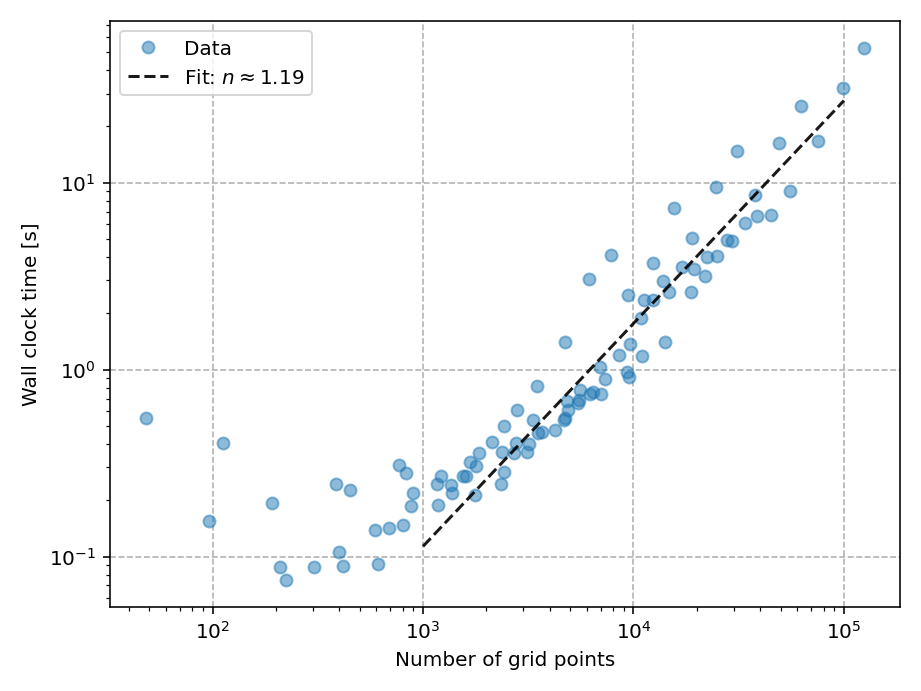
Scaling of the wall-clock time with respect to the total number of grid points, which is the product of the number of radial shells times the number of angular grid points.
Energy
The figure below shows the relative error as a function of the number of radial shells and angular grid points. A clear systematic trend is observed: beyond a certain threshold, increasing the number of angular points no longer leads to a significant reduction in the relative error. This saturation occurs at approximately 200 angular points, indicating that a value of about 230 angular points is sufficient in practice.
With respect to the radial grid, a favorable balance between computational cost and accuracy is obtained when using 32 radial shells, which already results in a relative error below \(1 \times 10^{-4}\). For higher accuracy requirements, increasing the number of radial shells to 64 further reduces the error to approximately \(1 \times 10^{-6}\).
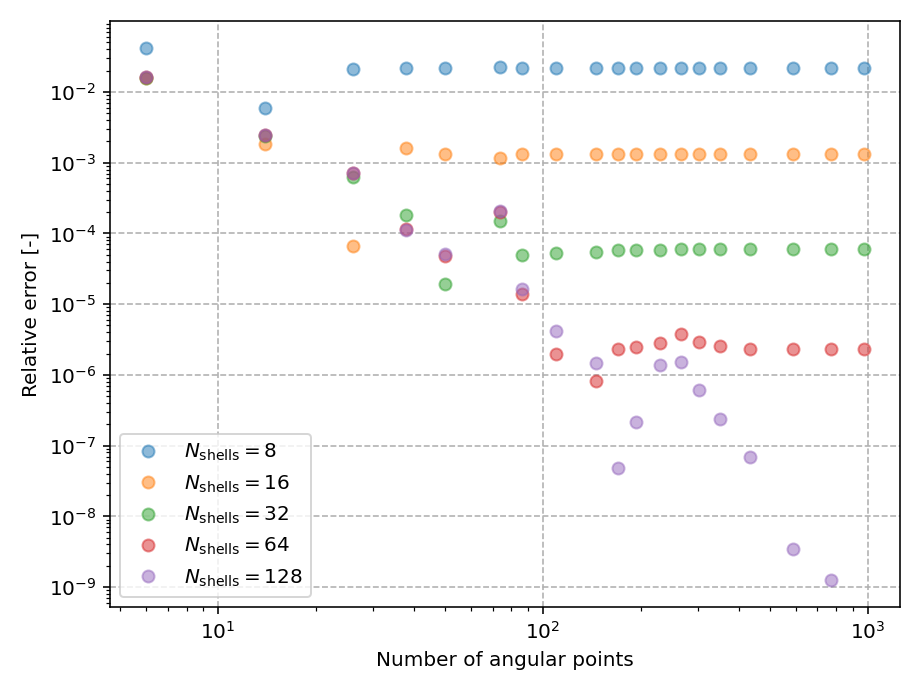
Relative error as function of the number of radial shells and the number of angular points.