Examples
On this page a series of typical usage scenarios are given, including the result and scripts to reproduce them.
Qualitative MO diagram
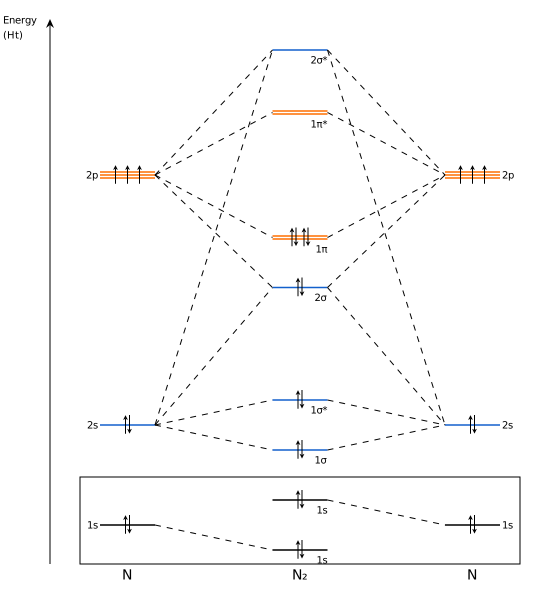
One can easily make their own MO diagram without the need of doing electronic structure calculations. The only thing needed are the relative MO energies, MO coefficients, the atoms involved, and some basic settings. Below an example is shown that makes a qualitative MO diagram for N2.
N2 diagram
from pymodia import MoDia, MoDiaData, MoDiaMolecule, MoDiaFragment, subscript
import os

# MO data
orbe = [-15.1, -14.9, -1.2, -0.8, 0.1, 0.5, 0.5, 1.5, 1.5, 2]
orbc = [[1, 0, 0, 0, 0, 0, 0, 0, 0, 0],
        [0, 0, 1, 1, 1, 0, 0, 0, 0, 1],
        [0, 0, 0, 0, 1, 1, 1, 1, 1, 1],
        [0, 0, 0, 0, 1, 1, 1, 1, 1, 1],
        [0, 0, 0, 0, 1, 1, 1, 1, 1, 1],
        [0, 1, 0, 0, 0, 0, 0, 0, 0, 0],
        [0, 0, 1, 1, 1, 0, 0, 0, 0, 1],
        [0, 0, 0, 0, 1, 1, 1, 1, 1, 1],
        [0, 0, 0, 0, 1, 1, 1, 1, 1, 1],
        [0, 0, 0, 0, 1, 1, 1, 1, 1, 1]]
ao_e = [-15, -1, 1, 1, 1]

# Setting up PyMoDia objects
mol_name = subscript("N2")
mol = MoDiaMolecule(mol_name, orbe, orbc, 14)
n1 = MoDiaFragment('N', ao_e, 7, {i:i for i in range(5)})
n2 = MoDiaFragment('N', ao_e, 7, {i+5:i for i in range(5)})
data = MoDiaData(mol, n1, n2)

mo_colors = ["#000000", "#000000", "#1260CC", "#1260CC", "#1260CC",
            "#FE6E00", "#FE6E00", "#FE6E00", "#FE6E00", "#1260CC",
            "#1260CC"]
ao_colors = ["#000000", "#1260CC", "#FE6E00", "#FE6E00", "#FE6E00"]
mo_labels = ['1s', '1s', '1σ', '1σ*', '2σ', '1π', '1π', '1π*', '1π*', '2σ*']

diagram = MoDia(data, orbc_cutoff=0.9, mo_color=mo_colors, ao1_color=ao_colors,
                ao2_color=ao_colors, draw_energy_labels=False,
                mo_labels=mo_labels, draw_level_labels=True,
                level_labels_style='mo_ao')

# Save image
diagram.export_svg(os.path.join(os.path.dirname(__file__), "mo_n2_qualitative.svg"))
Quantitative MO diagram
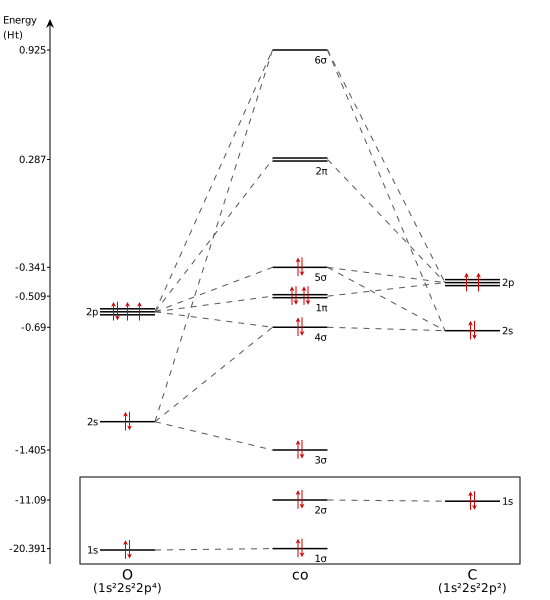
By making use of electronic structure calculation packages like PyQInt a more realistic MO diagrams can be made. Some rounding might be necessary to make sure degenerate levels have the (exact) same energy. Below an example is shown which produces an quantitative MO diagram of H2.
import os
from pymodia import MoDia, MoDiaData, autobuild_from_pyqint, MoDiaSettings
from pyqint import MoleculeBuilder, HF, FosterBoys

# Perform PyQInt calculations for CO and its localization
mol = MoleculeBuilder().from_name('co')
res = HF().rhf(mol, 'sto3g')

# adjust settings
settings = MoDiaSettings()
settings.orbc_color = '#555555'
settings.arrow_color = '#CC0000'

# attempt to automatically create mol and fragments from calculation
mol, f1, f2 = autobuild_from_pyqint(res, name='co')

# we make here a small adjustment to the height of the 5σ orbital to avoid
# overlap with the 2x2π MO
moe = res['orbe']
moe[6] += 0.1

# build data object
data = MoDiaData(mol, f1, f2)
data.set_moe(moe)

diagram = MoDia(data, draw_level_labels=True, level_labels_style='mo_ao',
                mo_labels=['1σ', '2σ', '3σ', '4σ', '1π', '1π', '5σ', '2π', '2π', '6σ'],
                settings=settings)
diagram.export_svg(os.path.join(os.path.dirname(__file__), "mo_co_canonical.svg"))